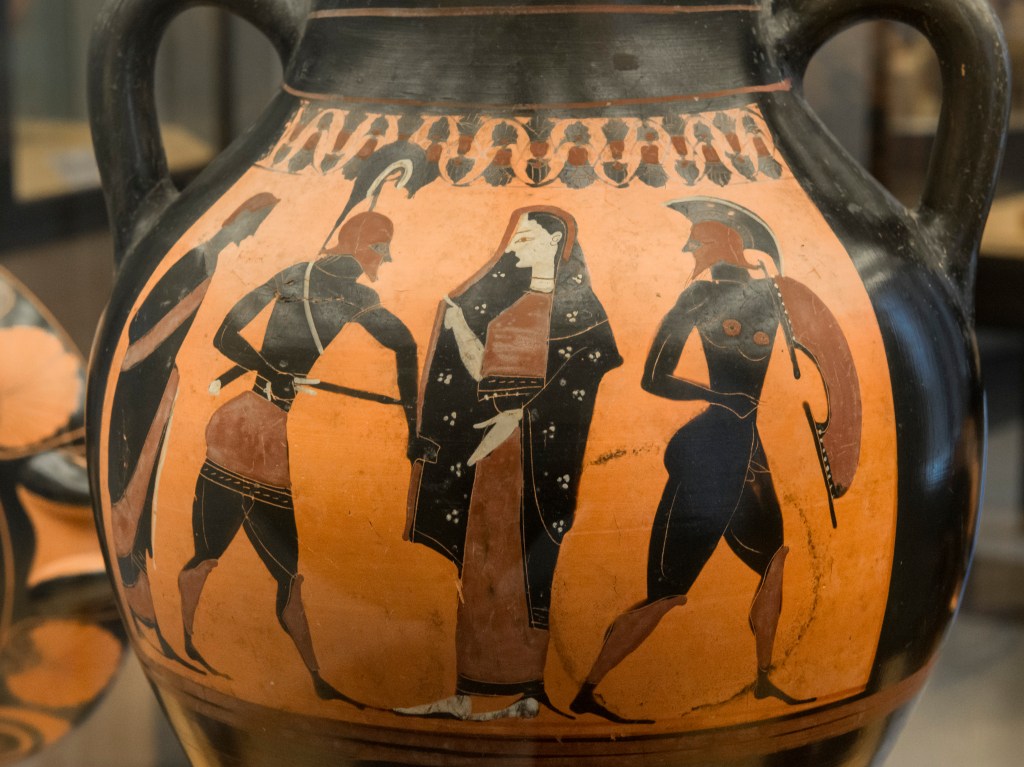
Title: Attic black-figured amphora B
Original: Athens
Creators: Attributed to the Painter of the Vatican Mourner (or Painter of Vatican)
Date: 530 BCE
Current Place: Vulci, Etruria Rome, Vatican Museums, Museo Gregoriano Etrusco
Work Type: Ceramic
Material: Terracotta
Description: This amphora describes the scene after Greek had conquered Troy. Menelaus was taking Helen back to Greek. The woman covering her head with a himation is Helen. She stands between two warriors. The one she is talking to is supposed to be Menelaus, the King of Sparta and the husband of Helen. The warrior on the right who carries a Boeotian shield might be another hero from the Greek, probably Agamemnon. Even though the war has ended, Agamemnon still holds his shield high up, representing the Greek warrior spirit stating that warriors should never loosen their minds. However, the reason for Menelaus to hold up his dagger might be different: First, it is possible that Menelaus may hate Helen for her betrayal, so he pretends to threaten her to teach her a lesson. Second, the blanket that Helen is wearing may be made in Troy. Menelaus hates the trojan so much that he wants everything from Troy to disappear. He wants to use his dagger to cut the blanket into pieces. His left hand grasping the blanket can be the best proof of this idea. That Helen’s one finger is pointing to Menelaus may mean that Helen is trying to persuade Menelaus not to do that. One mysterious part is about the man standing in the leftmost. Who is him? Why doesn’t he wear the armor? Why he wears in a different cloth style? I guess that can be a servant of Menelaus. However, his hands are putting in the back. Normally, putting the hands in front of the body means respect, while putting the hands backward means superiority. As a result, that can be someone else. If the Greek culture is different from my culture, that person may just be a servant. In the end, Helen and Menelaus enjoy the rest of their lives in the palace peacefully.
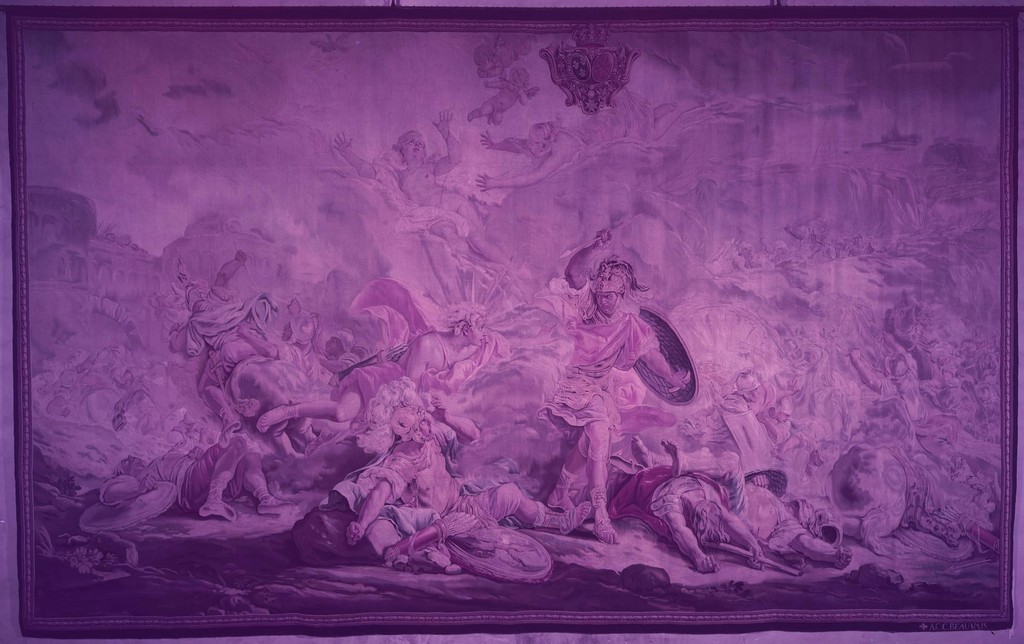
Painter: Creator: Deshays de Colleville, Jean-Baptiste-Henri (French, 1729-1765) Weaver: Charron, André-Charlemagne (French, fl.1754-1780)
Title: Venus intervenes in duel between Paris and Menelaus, Illiad, Set A
Work Type: Textiles – Tapestries
Date: 1761-1770 c.
Creation Location: Beauvais
Current Location: French Museum
Measurements: H 12′ x W 19’6″
Description: Jean-Baptiste-Henri is a French professional painter who received systematic training in both Rome and France. He painted this before he went to Rome. The picture described the scene of the duel between Menelaus-the king of Sparta, and Paris-the trojan who took Helen from Menelaus. When Menelaus is about to kill Paris with his dagger, the Goddess of Love Aphrodite appears and saved Paris my hiding him behind the cloud and mist. The cloud blocks Menelaus’s sight and makes him lose the target. The Painter emphasizes the anger of Menelaus, as he portrays Menelaus’s face with ferocious facial expression, as all his facial features twisted closely. That Menelaus’s widely opened eyes directly stare at Aphrodite further intensify that anger, anger of missing the chance of killing Paris. On the other hand, Paris—beaten to the ground by Menelaus and lifting his arm to make it as the last defense—shows the fear toward the death and Menelaus through his intimidating face. Aphrodite clearly exposed her worry toward Paris, as she stretches out her hand trying to grasp Menelaus to stop him from killing Paris. Her panic eyes shows that she is restless. The author also tries to describes the war as brutal: he paints the warriors’ armor and clothes in red- the color of blood and the symbol of hotness. Furthermore, the few bodies lied around Menelaus and those fighters fighting behind further enhance the brutality of the war. One interesting thing is that I do not see the cloud that saves Paris life, as described in the book Illiad. Maybe that dime-blue wrinkled cloth around Aphrodite’s left hand is the cloud. There are also few gods flying in the sky; a scene doesn’t appear in the Illiad. It can be a symbolic meaning representing that many gods are involved in the Trojan War, or it can be the author’s imagination that diversifies the scene. Still, this duel is the most important one in Trojan war because it directly makes Greece decide to completely conquer Troy, as trojans break the promise of duel and cheated even though those trojans are manipulated by gods. The gods still control the human world, and Troy’s destruction is fate.

Title: Vase (amphora) with painted decoration.
Work Type: Ceramic / Antiquity
Date: Ca. 550–525 B.C.
Material: Terracotta (black-figured).
Period: GREEK / late VI–early V century B.C.
Size: Height: 59.3 cm. (23 3/8 in.).
Current place: The University Museum, Philadelphia
Scene: related to the Aithiopis, in which Menelaus is killing an Ethiopian warrior identified as “Amasos.”
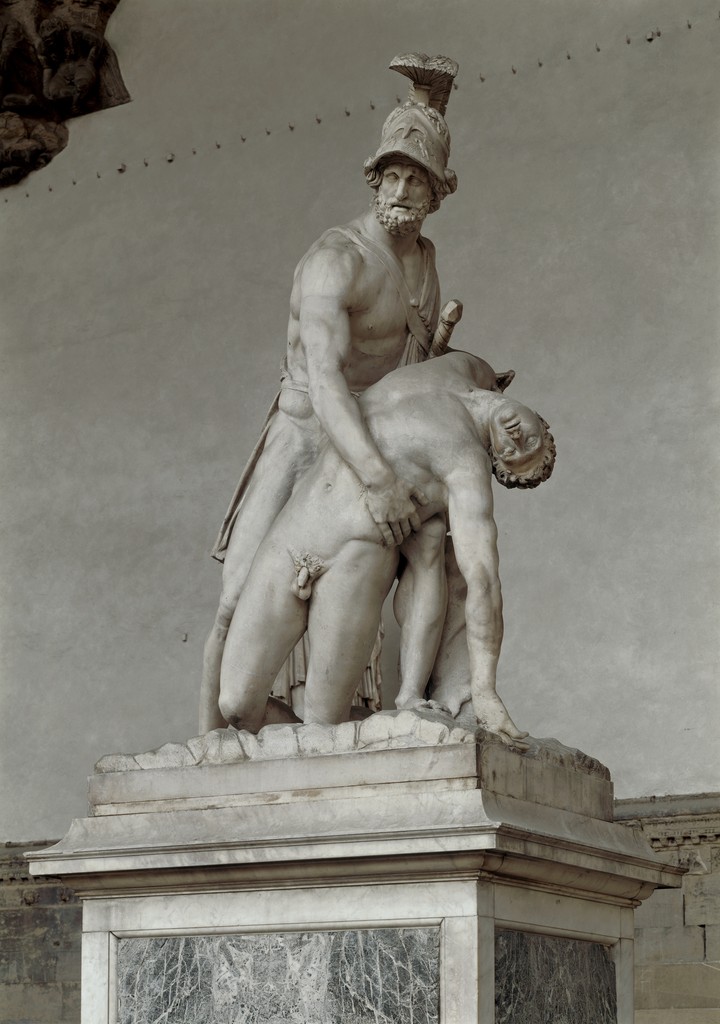
Title:Menelaus with the Body of Patroclus; Roman copy of a Hellenistic original
Location: Loggia della Signoria (Florence, Italy)
Period: late classical
Work Type: Sculpture
Scene: Menelaus is carrying the body of Patroclus when the war ends.
 trojanwar.music.blog